
Jewelry Trends 2026: What Fine Jewelry Brands Need to Know


Understanding where the fine jewelry market is heading is not about chasing fashion. It is about making informed creative and commercial decisions — knowing which aesthetic directions are gaining momentum, which materials are rising in demand, which customer values are reshaping purchasing behavior, and how to translate all of this into a collection that feels current without sacrificing the timeless quality that fine jewelry requires.
This guide covers the key jewelry trends defining 2026 across design aesthetics, materials, gemstone choices, and consumer values — and explains what each trend means practically for brands designing and manufacturing fine jewelry collections this year.
Why Trend Awareness Matters for Fine Jewelry Brands
Fine jewelry operates on longer cycles than fashion — a well-designed piece should remain relevant for years, not just one season. This does not mean trend awareness is irrelevant. It means trend awareness must be applied differently in fine jewelry than in ready-to-wear or costume jewelry.
For fine jewelry brands, the value of understanding trends lies not in reacting to them immediately but in identifying the ones with staying power — the directions that reflect a genuine shift in customer values or aesthetic sensibility rather than a momentary spike driven by a single campaign or celebrity moment. The brands that navigate trends most successfully are those that identify the underlying shift early, translate it into designs that feel considered rather than reactive, and execute it at a quality level that will stand the test of time.
This also shapes how you work with your manufacturing partner. Trend-informed design decisions have direct implications for material sourcing, stone selection, setting complexity, and production timelines. Discussing your creative direction at the earliest possible stage of collection development — before design decisions are locked — allows your manufacturer to advise on feasibility, source materials ahead of demand peaks, and plan production capacity accordingly. Our guide on how to design a jewelry collection walks through the full process of translating creative direction into a producible collection.
Trend 1: Sculptural and Architectural Jewelry
What is driving this trend
One of the strongest design directions in fine jewelry in 2026 is a move toward sculptural, three-dimensional forms — pieces that function as wearable objects rather than simply decorative accessories. This trend is driven by a growing customer appetite for jewelry that makes a statement beyond conventional ornamentation, and by the technical capabilities of modern production methods — particularly CAD design and advanced casting techniques — that make complex three-dimensional forms achievable at scale.
Sculptural jewelry draws from architecture, industrial design, and fine art. It favors strong geometric forms, deliberate negative space, asymmetry, and a material-forward aesthetic in which the metal itself — its weight, its surface, its form — is as much the subject of the design as any stone it might carry.
What this means for your collection
For brands exploring sculptural jewelry, the production implications are significant. Complex three-dimensional forms require careful engineering at the CAD stage to ensure they can be cast successfully, are structurally sound for wearability, and can be finished consistently at scale. Wall thicknesses, undercut angles, and weight distribution all require close collaboration between the designer and the manufacturer's technical team from early in the development process.
Our article on CAD jewelry design explains how CAD enables the kind of three-dimensional complexity that sculptural jewelry requires — and why investing in high-quality CAD development is especially important for structurally ambitious designs. Everything you need to know about casting in jewelry production covers the production method that brings these forms to life.
Trend 2: Colored Gemstones as the Hero
What is driving this trend
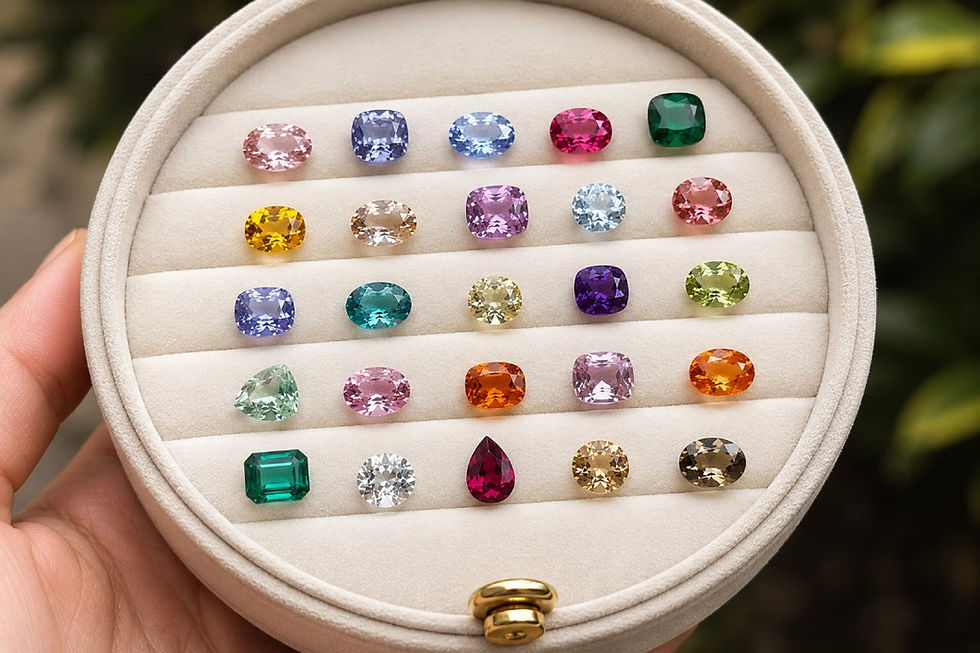
Colored gemstones — sapphires, rubies, emeralds, tourmalines, spinels, and a growing range of lesser-known stones — are experiencing a significant moment in fine jewelry in 2026. Several forces are converging to drive this: a growing consumer desire for individuality and personal expression over the uniformity of white diamond jewelry, increased awareness of and interest in gemstone provenance and origin stories, and the commercial appeal of offering distinctive, colorful pieces at price points that can be more accessible than equivalent diamond jewelry.
The colored gemstone trend is not uniform. There is strong demand for both vivid, saturated stones in classic hues — Burmese ruby red, Kashmir sapphire blue, Colombian emerald green — and for unusual, less commercially familiar stones that offer genuine rarity and a conversation piece: Paraíba tourmalines, alexandrites, Padparadscha sapphires, and a range of African garnets and spinels.
What this means for your collection
Integrating colored gemstones into a collection requires careful attention to sourcing, setting compatibility, and quality consistency across production runs. Unlike diamonds, colored gemstones are not graded to a universal standard — color quality, saturation, tone, and inclusion characteristics vary significantly between stones of nominally the same specification. Producing a consistent run of matched colored gemstone pieces requires working with a manufacturer who has strong gemstone sourcing relationships and the expertise to select and match stones to a consistent standard.
Bangkok is one of the world's premier colored gemstone trading hubs — giving manufacturers based there direct access to an extraordinarily broad range of stones from across Southeast Asia and Africa. Our professional guide on choosing the right gemstones for your collection covers the full spectrum of colored gemstone options and what to look for in quality and sourcing. Our article on how to source ethical gemstones addresses the provenance questions that increasingly matter to fine jewelry customers.
Trend 3: The Return of Maximalism
What is driving this trend
After several years in which minimalism dominated fine jewelry — thin bands, single stones, delicate chains — there is a strong and growing counter-movement toward maximalism. Statement earrings with significant drop and volume. Layered necklaces with mixed textures and stone types. Cocktail rings with large center stones and elaborate surrounds. Bold cuffs and wide bracelets that make an unapologetic claim on the wrist.
This maximalist direction is driven partly by a post-restraint cultural mood — a desire for joy, celebration, and visible investment in beauty — and partly by the influence of the resale and vintage jewelry market, which has brought elaborate, ornate historical jewelry styles back into cultural conversation. The grandeur of Victorian mourning jewelry, the geometric opulence of Art Deco, the color-saturated exuberance of mid-century cocktail jewelry — all of these references are visible in contemporary maximalist fine jewelry design.
What this means for your collection
Maximalist jewelry presents both design and production opportunities. Elaborate multi-stone pieces, complex cluster settings, and large-format statement pieces create the opportunity to showcase technical excellence — the kind of intricate setting work that clearly communicates the value of fine craftsmanship. They also require more sophisticated production planning: more complex setting, longer labor time per piece, more careful stone sourcing for matched sets, and higher per-piece production costs that must be reflected in realistic pricing.
If you are planning to introduce maximalist statement pieces into a collection that has previously been dominated by minimalist designs, ensure your pricing architecture can accommodate the production cost differential. Our guide on how to price your jewelry collection for retail and wholesale provides the framework for pricing more complex pieces without compressing your margins.
Trend 4: Sustainable and Traceable Materials
What is driving this trend
The demand for sustainability in fine jewelry is no longer a niche concern — it is entering mainstream purchasing behavior, particularly among younger fine jewelry customers who are accustomed to applying sustainability criteria to other categories of consumption and who increasingly expect the same from jewelry. This manifests in demand for recycled precious metals, lab-grown diamonds, traceable colored gemstones, and transparency about the environmental and social conditions of production.
Importantly, this trend is not simply about marketing. Customers are increasingly sophisticated — they can distinguish between genuine sustainability commitments and superficial claims. Brands that make credible, specific, documented sustainability claims are rewarded with customer trust and loyalty. Brands that make vague or unsubstantiated claims are increasingly exposed by more informed customers and journalists.
What this means for your collection
Responding to the sustainability trend requires decisions at the material sourcing level — choosing recycled gold alloys, specifying lab-grown diamonds for certain collection categories, working with a manufacturer who has supply chain transparency — and at the communication level, being honest and specific about what you can and cannot verify about your materials' provenance.
Working with a manufacturer who has the sourcing relationships and certification infrastructure to support traceable, responsibly sourced materials is a prerequisite for credible sustainability claims. Our article on ethical jewelry certifications covers the standards that matter most — from Kimberley Process and RJC certification to Fairmined gold and lab-grown diamond verification. Our piece on how to source ethical gemstones provides a practical framework for integrating traceable stones into your collection.
Trend 5: Mixed Metals and Tonal Contrasts
What is driving this trend
The convention that fine jewelry should be produced in a single metal — yellow gold, or white gold, or silver — is giving way to a more adventurous approach in which contrasting metals are deliberately combined within a single piece or across a coordinated set. Yellow gold combined with oxidized silver. Rose gold against white gold. Bi-color pieces that play with the visual contrast between warm and cool metal tones.
This trend reflects the broader cultural shift toward personal expression and rule-breaking in jewelry styling — a customer who wears yellow gold and white gold together on the same hand, who mixes vintage and contemporary pieces, who treats jewelry as a form of creative self-expression rather than adherence to convention. Brands that can offer pieces designed explicitly for mixing and layering are well positioned to capture this customer.
What this means for your collection
Mixed metal production requires additional technical considerations. Different metal alloys have different working properties, different finishing requirements, and different durability profiles — and combining them in a single piece requires careful engineering to ensure the joints between metals are strong and the finishing is consistent across both. Discuss mixed metal designs with your manufacturer's technical team early, before finalizing your CAD models, to ensure the production approach is sound. Our article on the best materials for fine jewelry covers the properties of each metal and the technical factors that shape mixed metal design decisions.
Trend 6: Personalization and Bespoke Elements
What is driving this trend
Personalization has been building as a trend in jewelry for several years — and in 2026 it shows no signs of slowing. Customers want jewelry that is uniquely theirs: pieces that carry their initials, their birthstone, a significant date, a meaningful symbol, or a completely bespoke design developed specifically for them. This desire for uniqueness is driven by the same forces as the broader move toward personal expression — a rejection of mass production and a desire for objects that carry genuine individual meaning.
For fine jewelry brands, personalization presents both an opportunity and an operational challenge. The opportunity is significant: personalized pieces command higher prices, generate stronger emotional attachment, and drive powerful word-of-mouth referral. The challenge is that personalization adds complexity to production workflows — managing individual specifications across multiple orders, ensuring quality consistency across bespoke pieces, and maintaining production efficiency when no two pieces are identical.
What this means for your collection
Introducing personalization into your collection requires close coordination with your manufacturing partner on the production workflow for bespoke elements. Engraving, birthstone substitution, initial setting, and size customization are all relatively straightforward to integrate. More elaborate bespoke design — where the customer participates in the design of the piece itself — requires a more structured design consultation and production process. Our piece on OEM and ODM jewelry manufacturing explains how both models can accommodate different levels of customization, from standardized personalization to fully bespoke production.
Trend 7: Fine Jewelry for Everyday Wear
What is driving this trend
The line between fine jewelry and everyday jewelry has been blurring for several years — and in 2026 the customer who wears a solid gold ring or a diamond stud every day, not just for special occasions, is now the mainstream rather than the exception. This shift reflects a broader cultural change in which jewelry is treated as a form of self-expression and personal investment rather than reserved for formal occasions.
The everyday fine jewelry customer prioritizes wearability alongside beauty — pieces that are comfortable, durable, low-maintenance, and designed to be worn continuously without snagging, irritating, or losing their finish. This places specific requirements on design and production: smooth edges, secure settings, durable surface finishes, and metal gauges that hold their shape under daily wear conditions.
What this means for your collection
Designing for everyday wearability requires translating wearability requirements into specific design and production specifications. Bezels and flush settings over prong settings for pieces worn on hands. Smooth, rounded profiles on rings and bracelets. Rhodium plating on white gold to protect against surface wear. Heavier gauge metal for pieces worn continuously. These are decisions that should be made at the design stage — not discovered as problems in finished goods. Our article on stone setting techniques covers which setting styles are most appropriate for everyday wearability, and our piece on the difference between handcrafted and mass-produced jewelry explains how production method affects durability and finish longevity.
How to Translate Trends Into Your Next Collection
Understanding trends is only valuable if it informs action. Here is a practical framework for integrating trend intelligence into your collection development process without losing your brand identity in the process.
Filter trends through your brand identity
Not every trend is right for every brand. The first question to ask of any trend is not "is this popular?" but "is this consistent with who we are and what our customer values?" A brand built on architectural minimalism should not pivot to maximalist cocktail jewelry simply because maximalism is trending. But that same brand might find within the maximalism trend a specific element — bold negative space, a single large sculptural stone — that can be interpreted through its own design vocabulary without contradiction.
Your brand identity is the filter through which trend intelligence passes on its way to becoming a design decision. Our article on how to build a jewelry brand identity that sells explains how to develop and maintain a brand identity strong enough to guide these decisions consistently.
Identify the trend's underlying shift
Every trend is the visible expression of an underlying shift in customer values, cultural mood, or market behavior. Understanding the underlying shift allows you to respond to it more durably and authentically than simply replicating the trend's surface appearance. The colored gemstone trend is not really about colored gemstones — it is about the desire for individual expression and uniqueness. The sustainability trend is not really about recycled gold — it is about the desire for trust and transparency. Designing to the underlying shift produces collections with more lasting relevance than designing to the surface trend.
Plan your production timeline around trend cycles
Fine jewelry production timelines are long — from design to finished goods typically takes three to six months. This means the collection you are designing today will not reach customers until well into next year, by which point the trend landscape will have shifted again. Successful fine jewelry brands plan their collections twelve to eighteen months ahead of market, using trend intelligence from runway shows, trade fairs, and market research to anticipate where the market will be — not where it is today. Our article on how to work with a jewelry manufacturer covers the production timeline in detail and explains how to build a collection calendar that accounts for these long lead times.
Frequently Asked Questions
What are the biggest fine jewelry trends in 2026?
The most significant fine jewelry trends in 2026 include sculptural and architectural design forms, colored gemstones as the design hero, a return to maximalist statement pieces, growing demand for sustainable and traceable materials, mixed metal combinations, personalization and bespoke elements, and the continued rise of fine jewelry designed for everyday wear. These trends reflect broader shifts in consumer values — toward personal expression, transparency, and jewelry as a form of meaningful self-investment rather than occasional adornment.
How do I incorporate trends without making my collection feel dated quickly?
The key is to distinguish between trend-driven surface details and the underlying shifts in customer values that drive them. Design to the underlying shift — not the surface expression — and execute it through your brand's own design vocabulary. A trend-informed collection that has been filtered through a strong, consistent brand identity will remain relevant longer than one that simply replicates trend imagery. Investing in timeless production quality also ensures that pieces remain beautiful and wearable long after a specific trend has evolved.
How far in advance should I start designing a trend-informed jewelry collection?
Fine jewelry brands should be designing collections twelve to eighteen months ahead of their intended market date — accounting for design development, CAD modeling, prototype sampling, production, and delivery. This means the trend intelligence informing your next collection should be gathered now, not when you are ready to start designing. Trade shows like Couture, Vicenza Oro, and Bangkok Gems & Jewelry are important sources of early trend direction, as are the runway collections of major fashion houses, which often anticipate fine jewelry aesthetic shifts by one to two seasons.
Are lab-grown diamonds still a strong trend in 2026?
Lab-grown diamonds remain commercially significant in 2026, particularly in the accessible fine jewelry segment where their lower price point relative to natural diamonds allows brands to offer larger stones at accessible retail prices. However, the luxury and investment fine jewelry segment continues to favor natural diamonds, where rarity and provenance remain key value drivers. The most nuanced approach is to understand where your specific customer sits on this spectrum and to make your material choices accordingly — rather than treating lab-grown versus natural as a binary brand position.
How do colored gemstone trends affect production planning?
Colored gemstone trends affect production planning primarily through sourcing lead times and stone consistency requirements. Popular stone types — Paraíba tourmalines, Padparadscha sapphires, Burmese rubies — can be subject to supply constraints when demand spikes, making early sourcing essential for brands that want to incorporate them into a collection. Discuss your gemstone requirements with your manufacturer well in advance of your production start date, and be prepared to be flexible on specific stone parameters if your first-choice specification is in short supply. Working with a Bangkok-based manufacturer gives you direct access to one of the world's most diverse and deep colored gemstone markets, which significantly reduces sourcing risk.


Comments